Company news
UniBio Intelligence Achieves Top-Tier Performance in OpenADMET Structure Prediction Challenge
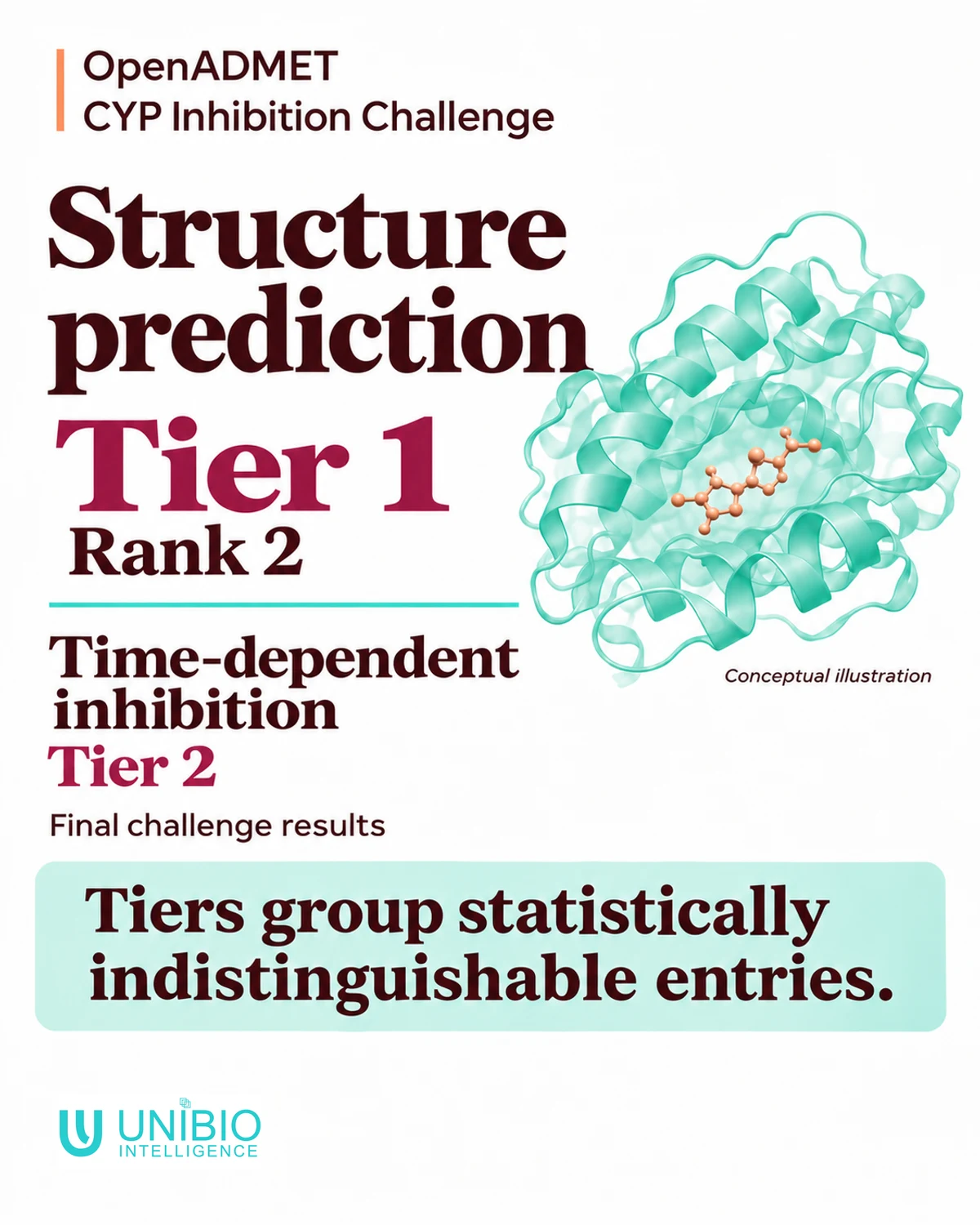
Company earns Tier 1 in structure prediction and Tier 2 in time-dependent inhibition in the final CYP challenge results.
BAR HARBOR, Maine, November 6, 2026 — UniBio Intelligence today announced that it placed in the top tier (Tier 1) for structure prediction and Tier 2 for time-dependent inhibition prediction in the OpenADMET CYP Inhibition Blind Challenge. The results provide an external assessment of the company’s molecular prediction workflows against experimental data.
The challenge focused on cytochrome P450 (CYP) enzymes, which help metabolize many medicines. Inhibition of these enzymes can affect how other drugs are processed, making CYP inhibition an important consideration in drug discovery and the assessment of potential drug interactions.
In the structure prediction track, participants predicted how small molecules bind within CYP3A4. The submitted models were evaluated against 20 previously undisclosed cryo-electron microscopy complex structures. The company’s workflow combined Boltz-2 structure predictions with confidence-based selection and physical validity checks.
UniBio Intelligence also achieved Tier 2 in the time-dependent inhibition (TDI) track, which evaluated predictions for CYP2D6 and CYP3A4. The TDI field included teams from NVIDIA and Recursion, alongside academic and independent researchers. The task assessed whether enzyme inhibition increases after preincubation.
Tiers group statistically indistinguishable entries. OpenADMET uses statistical comparisons to group submissions whose performance could not be distinguished under its evaluation procedure. Tier 1 is the highest statistical performance group; the tiers account for uncertainty when interpreting differences in scores. The placements are reported on the official final leaderboards.
UniBio Intelligence has published a research report describing its approach and findings, including the experiments behind its structure and inhibition workflows. The report also credits public participant contributions, including Jeremycheminf’s CYP3A4 predictions used alongside the company’s CYP2D6 predictions in its TDI submission.
UniBio Intelligence thanks OpenADMET, Octant, UCSF, and the research community for the experimental data, challenge infrastructure, and openly shared methods that made this evaluation possible.
About UniBio Intelligence
UniBio Intelligence is a computational biology company based in Bar Harbor, Maine. It builds infrastructure connecting mechanistic models, scientific tools, and biomedical data through Ubi Biologics, and works with research teams on custom modeling, analysis, and platform integrations. Learn more at unibiointelligence.com.
Sources and related reading
- [1] OpenADMET. Take Me Heme, Binding Modes: Wrapping up the CYP Inhibition Challenge. 2026.
- [2] OpenADMET. CYP Inhibition Blind Challenge final leaderboards. Hugging Face, 2026.
- [3] Kohar, V. Predicting CYP Inhibition and Structures: What We Learned in OpenADMET. UniBio Intelligence Blog, updated November 2, 2026.
Citing this article
@misc{unibio2026openadmet,
  author = {{UniBio Intelligence}},
  title = {UniBio Intelligence Achieves Top-Tier Performance in OpenADMET Structure Prediction Challenge},
  year = {2026},
  month = {November},
  url = {https://unibiointelligence.com/blog/openadmet-cyp-challenge-results/}
}