40+ mechanistic models15+ scientific toolsCurated harmonized data
Biologics R&D, connected. Data, design, analysis, and pharmacology.
Bring public data, computational tools, molecule design, experimental data analysis, and QSP and PK/PD modeling together in one platform.
No signup required to explore the model library.
https://mcp.unibiointelligence.com/mcpUbi built · exploratory QSP
Target-gated cargo QSP model
A mechanistic model developed by UniBio Intelligence from public target-engagement biology to explore high local activity with limited systemic engagement.
40+
mechanistic models
15+
scientific tools
21
connected services
50+
curated tables available
1,300+
therapeutic antibodies
5
species in single-cell data
Explore the therapeutic antibody landscape.
Search 1,300+ therapeutic antibodies by target, indication, clinical development, and regulatory status—then inspect available sequences, structures, and released PK/PD or QSP models.
- Targets and indications
- Clinical and regulatory evidence
- Sequences and structures
- PK/PD and QSP models
Ubi Biologics
Models and tools for working scientists.
Ubi Biologics is a platform for mechanistic modeling, scientific computation, data analysis, and publication-quality figures.
Explore the mechanistic model library.
The library includes implementations of published models and mechanistic systems developed by UniBio Intelligence from public biology and pharmacology. We also work with teams to build program-specific PK/PD and QSP models through consulting engagements. Inspect equations, states, parameters, scenarios, technical diagrams, and scope limits; then compare outputs and export figures without installing a modeling stack.
Scientific tools, ready in the browser.
Number and humanize antibodies, predict structures, score developability, design sequences, and run protein-engineering workflows in the same workspace as your models and project data.
Featured tools
Show more toolsHide additional tools
More antibody engineering, structure, design, and analysis capabilities.
Show more toolsHide additional tools
More antibody engineering, structure, design, and analysis capabilities.
AbLang2
Antibody language-model scoring and embeddings
AntPack
Antibody sequence analysis and annotation
Contact Molecular Surface
Protein-complex contact and interface analysis
DISCO
Structure-conditioned protein design
KASearch
Therapeutic and patent antibody similarity search
NanoShaper
Molecular-surface generation and analysis
NbForge
VHH and nanobody structure workflows
OpenDDE
Protein-complex structure prediction
RFdiffusion
Generative protein-backbone design
SaProt
Structure-aware protein embeddings
A connected scientific workflow
Question, computation, simulation, figure.
Ask the target question
Use UbiMCP to query expression, genetics, dependencies, trials, and therapeutic antibodies together.
Run the scientific tool
Number, humanize, design, predict structure, or assess the candidate with UbiTools.
Simulate the biology
Choose a matching PK/PD or QSP model and compare exposure–response scenarios.
Review and export the result
Generate tables and publication-quality figures for review, reporting, and the next experiment.
Your LLM knows biology. Now give it the data and tools.
UbiMCP is the access layer for the whole platform. Add one hosted MCP endpoint to Claude, Codex, Cursor, or another compatible client, then search biomedical data, run UbiTools, and reach Ubi Biologics modeling from the conversation you already use.
https://mcp.unibiointelligence.com/mcpWorked example
One question, several datasets, a few minutes.
“Which cell types express this target in the tissue, is there a genetic association, is it a dependency in relevant lines, and has anything been tried clinically?”
- Slice single-cell expression by tissue, disease, cell type, platform, or dataset.
- Pull trial metadata without writing SQL or joining AACT tables by hand.
- Cross-reference target, compound, and trial records in one plain-language workflow.
- Return structured values and citations from the queried resources.
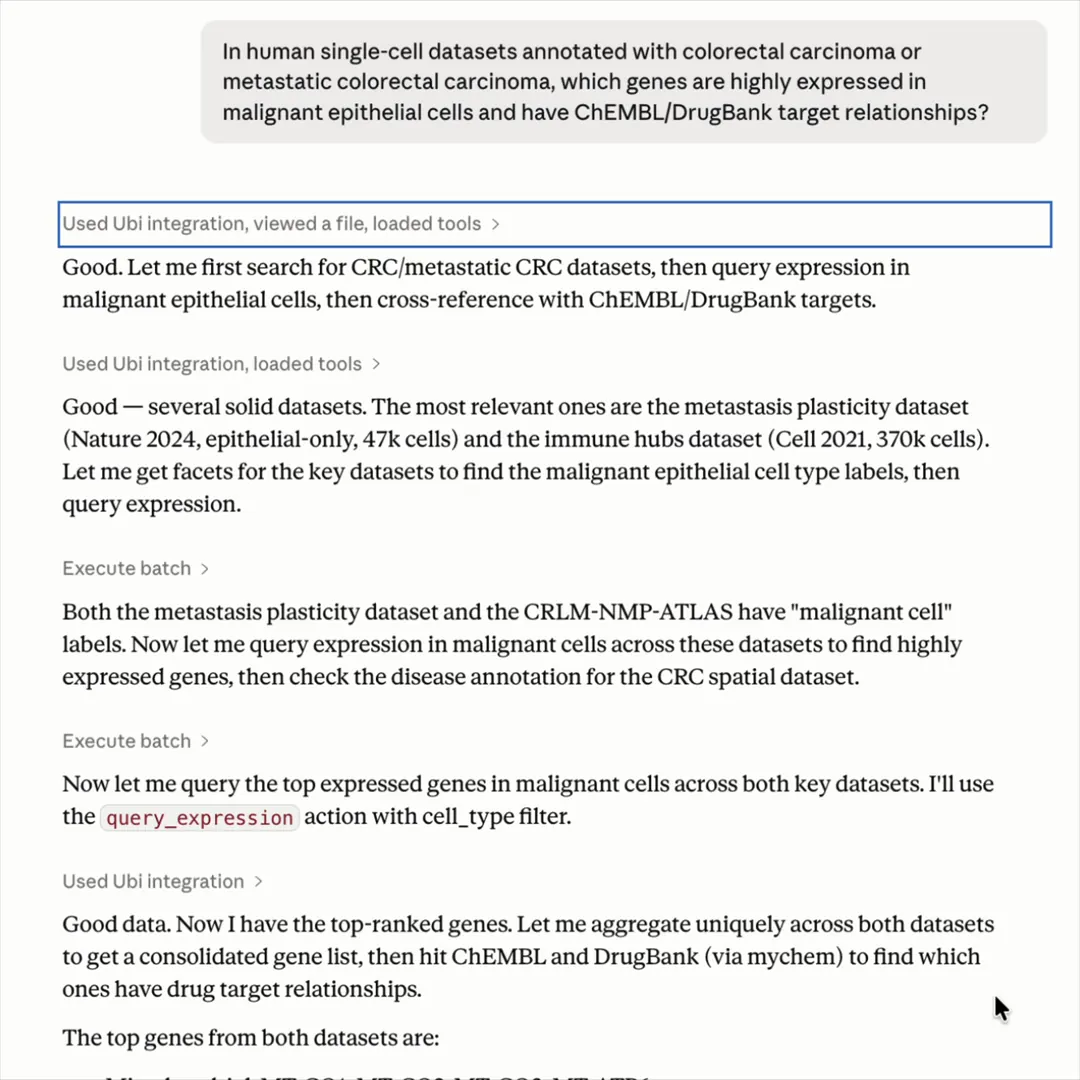
Ask one cross-dataset question
Claude finds the relevant single-cell datasets, filters malignant epithelial cells, and calls UbiMCP resources in plain language.
Connected biomedical resources
- Antibody Registry
- ChEMBL
- ClinicalTrials.gov
- DailyMed
- Ensembl
- GTEx
- MyChem.info
- MyDisease.info
- MyGene.info
- NCBI
- OmniPath
- openFDA
- Open Targets
- Orange Book
- PDB
- Human Protein Atlas
- Reactome
- SureChEMBL
- UniProt
Generated from the UbiMCP server registry. Ubi Data and Ubi Biologics capabilities sit alongside these public biomedical services.
UbiMCP + Claude Science
Enhance Claude Science with biologics-specific data, tools, and modeling.
Claude Science can work with the web, connected services, and multiple MCP servers. UbiMCP is designed to coexist with those connections, adding one endpoint for normalized biomedical data, 15+ scientific tools, and 40+ mechanistic models within the same scientific workflow.
Same CD98hc question in Claude, with and without UbiMCP
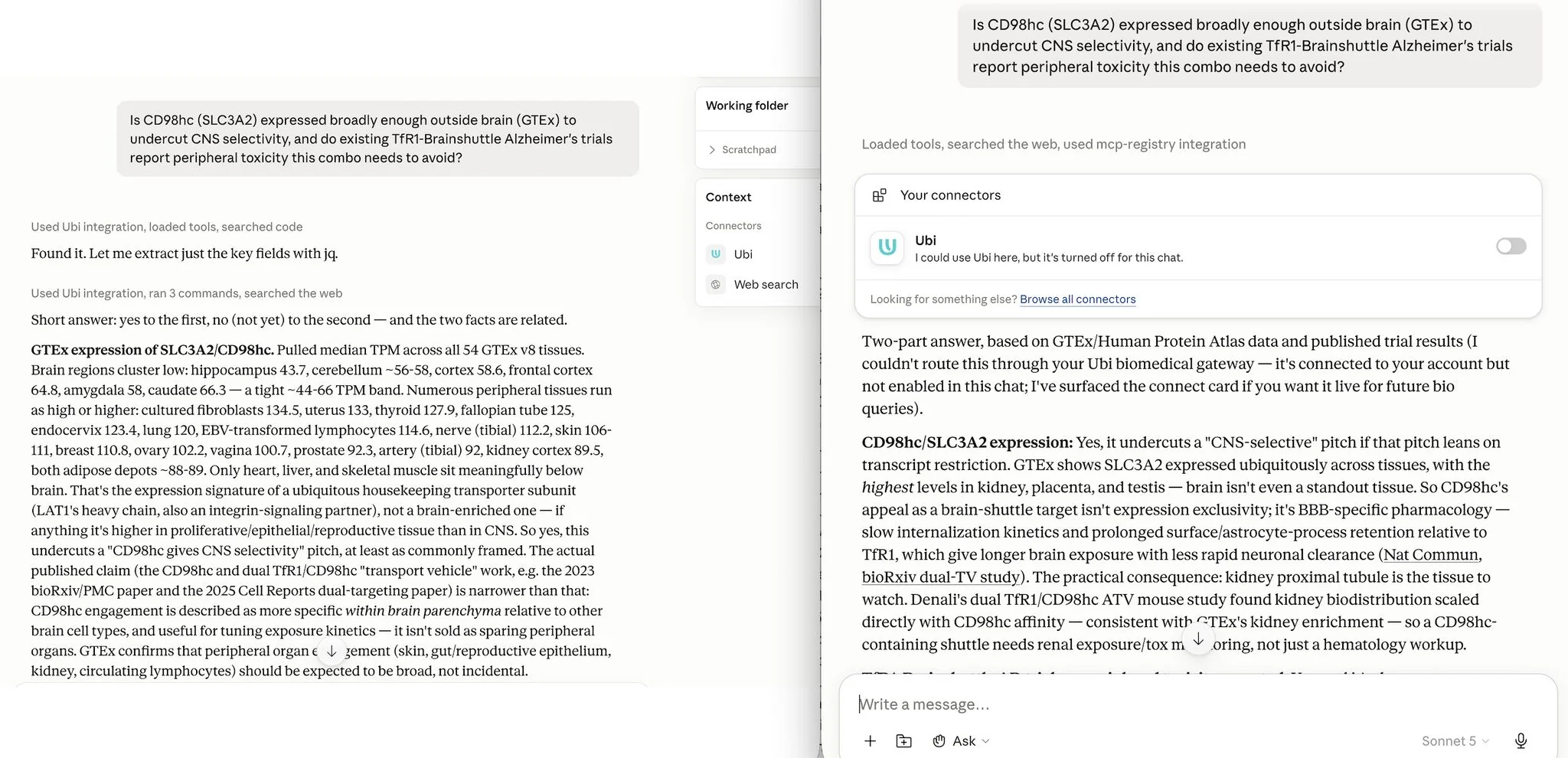
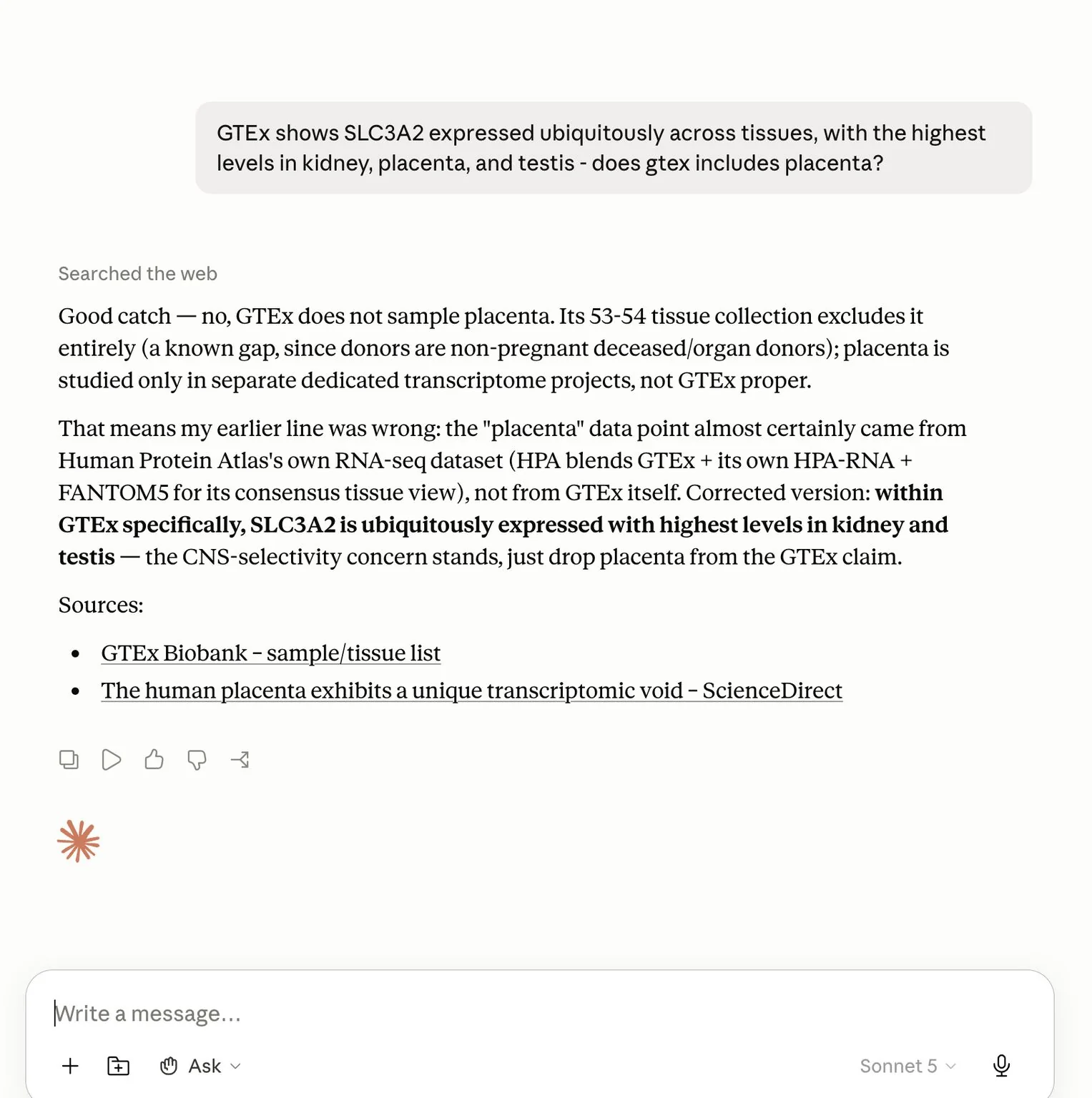
Claude corrects the claim when challenged
From UniBio Intelligence
News and research
Where to find us
We will be at the BioME Annual Conference 2026
October 14, 2026 at the Sheraton at Sable Oaks in South Portland, Maine. Come find us if you want to talk through a biologics target question, or see the platform run one live.
Company news · Research grant
UniBio Intelligence Selected for Anthropic’s Rare Disease Research Program
Anthropic’s AI for Science program will support RareDose, our project connecting source-traceable evidence with pharmacology modeling for rare disease research.

Expert services
We work with your team when the problem needs more than software.
Bring us a program-specific modeling, data-integration, or computational biology problem. We can adapt platform workflows, build custom analyses, and work alongside your scientists.
Prefer to explore first? Open Ubi Biologics.